Pay for Delete

What Is Pay for Delete and Does It Work in Houston, Texas

A Deal That Can Work — Only If It's in Writing First

Pay for delete sounds simple: you pay the collection, the collector deletes the account. In practice it is a negotiation, not a right — collectors are never required to agree, and an oral promise is worth nothing. This guide explains how pay-for-delete actually works and how to protect yourself if you try it.

What Pay for Delete Means

Pay-for-delete is an agreement between you and a collection agency: you pay the debt (or an agreed settlement amount), and the agency asks the credit bureaus to remove the collection account from your reports. It is a private agreement, not a right under the law. No statute requires a collector to delete an account after payment, and the bureaus' own reporting guidelines actually discourage the practice — which is why many large collectors refuse it outright, and why smaller ones may agree only in some cases.

That is the first thing to understand: pay-for-delete is never guaranteed. A collector can say no, and many do. A collector that says yes on the phone and then reports the account as paid — without deleting it — has not broken the law, because an oral promise to delete is almost impossible to enforce. The only version of pay-for-delete that protects you is a written agreement, signed by the collector, that states the amount, the payment date, and that the collector will request deletion of the account from all three bureaus.

The second thing to understand is that paying a collection without a deletion agreement still changes the account: it becomes a paid collection, which some newer scoring models treat more kindly than an unpaid one, and which some mortgage underwriters look at more favorably when they review a file by hand. Paying is not worthless without deletion — but it is not deletion either, and you should know which one you are getting before you send money.

Step by Step: Negotiating Pay for Delete

Step 1 — Verify the debt first. Before you negotiate anything, ask the collector for written validation: the amount, the original creditor, and proof the debt is yours. Do not agree that a debt is yours, and do not agree to a payment, until you have seen that validation. A debt with the wrong balance or the wrong creditor is a dispute, not a negotiation.

Step 2 — Check the dates. A collection nearing the end of its seven-year reporting window may fall off on its own within a year or two, and paying it will not make it disappear any sooner. A collection for a debt past the statute of limitations for lawsuits is a different negotiation from a fresh one. Know where the account stands before you offer anything.

Step 3 — Make the offer in writing. Write to the collector — mail or email, not just a phone call — and offer a specific amount in exchange for deletion of the account from all three bureaus. Collectors often accept less than the full balance, especially on older accounts. Start below what you are willing to pay, and be ready to negotiate.

Step 4 — Get the agreement in writing before you pay. This is the step that matters most. The written agreement should state the amount, the payment date and method, and that the collector will request deletion of the account from Equifax, Experian, and TransUnion. It should be on the collector's letterhead or from an authorized representative, and you should have it in hand before a single dollar moves. Do not pay first and ask for the letter after — once the money is sent, your leverage is gone.

Step 5 — Pay as agreed, then verify. Pay exactly as the agreement states, keep the receipt and a copy of the agreement, and check your reports 30 to 60 days later. If the account is still showing, send the bureau a dispute with a copy of the agreement attached. If the collector agreed in writing and did not follow through, that written agreement is your evidence.

When Pay for Delete Is Not the Right Move

Pay-for-delete is not worth pursuing for a debt you do not owe — that is a dispute. It is not worth pursuing for a medical collection you already paid — paid medical collections are removed anyway. It is not worth pursuing for a very small, very old collection that will fall off on its own soon. And it is not worth pursuing with a collector that has already told you, in writing, that it does not do pay-for-delete — that answer is usually final, and the negotiation is better spent on a settlement that at least gets the account marked paid.

Also be careful about restarting clocks. Paying a collection does not restart the seven-year credit reporting window — that runs from the date of first delinquency and cannot be restarted by payment. But in some situations, acknowledging an old debt or making a payment can affect the statute of limitations for a lawsuit, which is a separate clock. If the debt is old, understand both clocks before you engage.

When you dispute by mail, send it to the bureau that shows the item. The mailing addresses are: Experian, P.O. Box 4500, Allen, TX 75013; Equifax, P.O. Box 740256, Atlanta, GA 30374; and TransUnion, P.O. Box 2000, Chester, PA 19016. Bureaus generally have 30 days to investigate a dispute once they receive it. Send disputes by certified mail and keep a copy of everything you send, along with the delivery confirmation.

Related Guides and Services

If this guide helped, these pages go deeper on the topics that usually come up next.

A First Look at Real Results

These are actual results from past clients, previously shared on Instagram. Every credit file is different, so treat these as examples of what the process can look like, not as a promise of what yours will do.
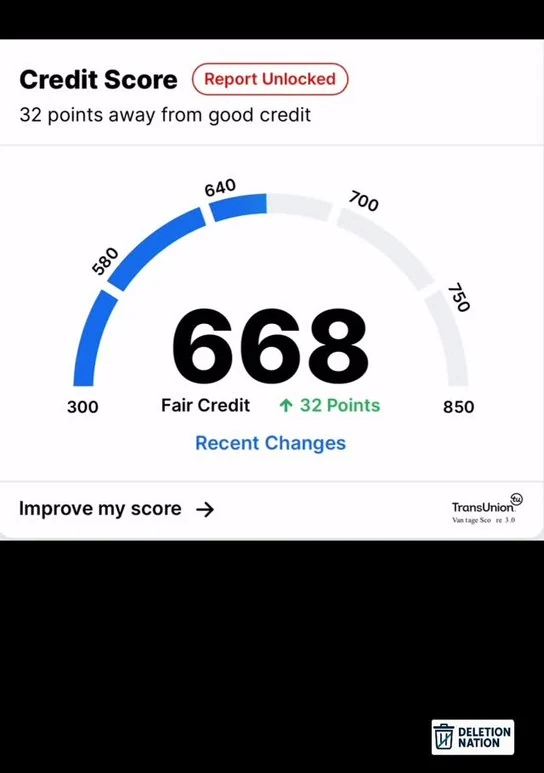
Houston credit repair result: TransUnion credit score of 668, up 32 points

Three clients, 13 deletions, one round

Three TransUnion clients cleared back to back in August 2025. One client had 8 inquiries deleted in a single sweep; another had Apple Card, Comenity, CareCredit, and USAA accounts removed; a third had a Synchrony account deleted. One client rose 32 points overnight, to 668.
See it on Instagram →

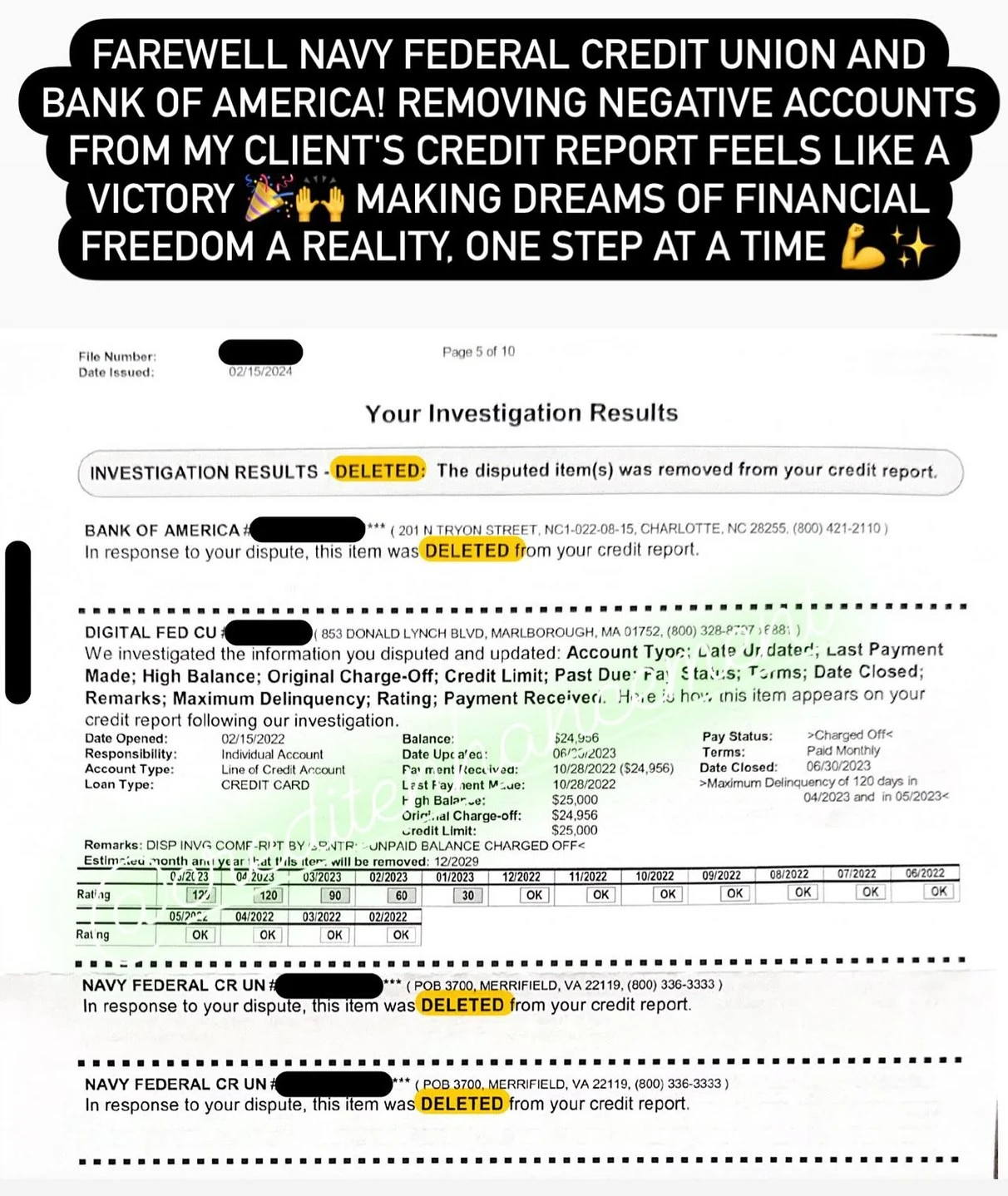
Houston credit repair result: Credit bureau investigation letter showing Bank of America and Navy Federal accounts deleted

Bank of America and Navy Federal, deleted

A February 2024 bureau investigation letter showing a Bank of America account and two Navy Federal accounts deleted from a client's credit report after dispute.
See it on Instagram →

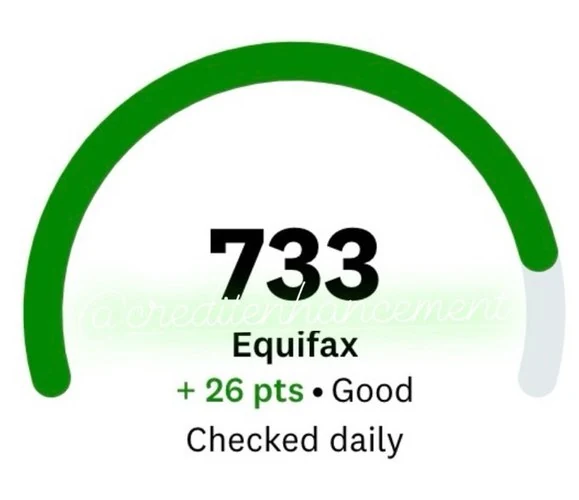
Houston credit repair result: Equifax credit score of 733, up 26 points

Equifax up 26 points

A client reached 733 on Equifax after a 26-point increase, March 2024.

See it on Instagram →

Results vary from person to person and depend on what is in each credit file. Nothing here promises a particular score increase or deletion.

See the Collections You're Negotiating About for a Dollar

You can't negotiate what you haven't read. Check every collection entry — the collector, the balance, the date — on all three bureaus before you contact anyone.

For a dollar, you can read your scores and entries from Equifax, Experian, and TransUnion before you decide what to do about them.

See What's on My Reports

A dollar with MyScoreIQ opens 7 days of access to your scores, then $34.99 a month if you keep it. Cancel anytime.

Houston Credit Repair Is Proud to Serve Texas

What We Walk Through With You

Pay for Delete can look different from one report to the next. We help you understand the details and spot accuracy problems.

The Debt Itself

We review the collection — the collector, the original creditor, the balance, and the dates — before any negotiation.

Validation Before Payment

We talk through asking a collector for written validation before you agree to anything.

The Offer

We explain how to make a pay-for-delete offer in writing, and what amount to start with.

The Written Agreement

We explain what the agreement must say before you send a payment.

Verification After Payment

We talk through checking your reports 30 to 60 days later to confirm the deletion.

Why Talk Through Pay for Delete With Us?

Start With the Facts

A Pay for Delete entry feels personal, but on a report it is just data — dates, amounts, and a status. We help you read it as data first.

One Entry, Three Reports

The same account can look different on each bureau. We help you check all three before you act on any one of them.

A Plan You Can Follow

We explain dispute options, what records to keep, and practical habits that help you stay current going forward.

How We Help With Pay for Delete

Go Over Your Collection Entries

We talk through the collection accounts showing on your credit reports.

Verify the Debt

We help you understand what validation to ask for and what to look for in the answer.

Plan the Negotiation

We explain pay-for-delete, settlement, and waiting options in plain language.

Check the Result

We explain how to confirm a deletion stuck on all three bureaus.

Questions About Pay for Delete

What is pay-for-delete?

Pay-for-delete is an agreement where a collection agency removes the collection account from your credit reports after you pay the debt or an agreed settlement amount. It is a private agreement, not a legal right.

Is pay-for-delete guaranteed?

No. Collectors are never required to agree, and many refuse. An oral promise is not enough — any agreement must be in writing before you pay.

What should a pay-for-delete agreement say?

The amount, the payment date and method, and that the collector will request deletion of the account from Equifax, Experian, and TransUnion. Get it on the collector's letterhead before you pay.

Does paying a collection remove it without an agreement?

No. Paying a collection without a deletion agreement changes its status to paid, but the account stays on the report for its normal window.

Should I try pay-for-delete on a very old collection?

Maybe not. A collection nearing the end of its seven-year window may fall off on its own soon, and paying it will not make it disappear any sooner.

Does paying a collection restart the seven-year clock?

No. The reporting window runs from the date of first delinquency and cannot be restarted by payment. The statute of limitations for a lawsuit is a separate clock — understand both before you engage.

Thinking About Offering Pay for Delete?

Get the agreement in writing first — before a dollar moves. Let's look at the collection and talk about whether it's worth the try. Call (346) 301-6424.

Call (346) 301-6424

Our Services in Houston, Texas