Credit Repair Timelines
Months, Not Days — and Anyone Who Promises Days Is Selling Something
The first question most Houstonians ask about credit repair is how long it takes. The honest answer is: it depends on what's in the file, and the timeline is measured in months, not days. This guide explains what sets the pace, what a realistic timeline looks like, and what actually moves the needle fastest.
The timeline for credit repair is set by three things: what is in the file, how much of it is inaccurate, and how the bureaus and creditors respond. A file with one or two clear errors — a wrong balance, an account that is not yours — can improve in a single dispute round, because bureaus generally have 30 days to investigate a dispute. A file with a bankruptcy, a foreclosure, and several collections will take far longer, because accurate negative items generally stay for about seven years and the improvement comes from aging, new on-time history, and gradual score recovery — not from any single action.
The dispute cycle itself sets a rhythm: a dispute takes about 30 days to investigate, the results arrive in writing, and a correction at one bureau does not always carry to the others, so the same error may need to be disputed at two or three bureaus in sequence. A second round of disputes, with stronger documentation, adds another 30 days. A goodwill letter can take 30 to 60 days to get an answer — or no answer at all. Realistic planning assumes several rounds over several months, not a single letter and a done file.
The other pace-setter is your own payment behavior. Payment history is the largest factor in most scoring models, and it only improves one month at a time. A file that shows six months of on-time payments after a period of lates looks different from a file that shows one month. There is no shortcut for that — time and consistency are the mechanism, and anyone who promises otherwise is not describing how scoring works.
Weeks 1–2: Read the file. Pull your reports from all three bureaus at annualcreditreport.com, the official site. Read them line by line, list every error, and gather the documents that prove each correction. This stage feels slow, but it is the one that determines whether everything after it works.
Weeks 3–6: First dispute round. Dispute the clearest errors with the bureaus and the creditors, by mail or online. Bureaus generally have 30 days to investigate. While you wait, bring any past-due accounts current and set up autopay so nothing new goes late.
Months 2–4: Results and second round. The first results arrive. Corrected entries should be verified on all three bureaus. Errors that came back verified get a second dispute with stronger documentation, or a direct approach to the creditor. Goodwill letters go out for one-off late payments on otherwise clean accounts.
Months 4–12: Rebuilding. With the errors addressed, the work shifts to building new history: a secured card or credit-builder loan paid on time, balances kept low, no new unnecessary applications. The score moves gradually as the new history accumulates and the old negatives age. A file with a bankruptcy or foreclosure is on a longer track — the entry itself stays for its full window, and the improvement comes from the clean history growing around it.
For most files, visible improvement in three to six months is realistic when there are genuine errors to correct. A file with no errors and only accurate negatives improves on a longer schedule, and the honest answer there is that time and on-time payments are doing the work — not a dispute letter.
The fastest legitimate improvement usually comes from paying down credit card balances. Utilization — how much of your available credit you are using — is a large scoring factor and it updates monthly, so paying a maxed-out card down below 30 percent of its limit, or below 10 percent, can move a score in a single billing cycle. It is the one lever that works quickly, and it works because the data changes every month.
Correcting a genuine error is the second-fastest lever: removing an account that is not yours, or correcting a balance that was wrong, changes the data the score is built from. But it depends on the error being real, and on the bureau agreeing after investigation — which takes about 30 days.
What does not move a score quickly: disputing accurate items, sending the same dispute repeatedly, buying a “tradeline,” or paying a company that promises deletions on a schedule. Accurate negative information generally stays for about seven years, and no amount of letters changes that. The companies that promise fast results are usually selling the dispute process itself — a process you can use directly — aimed at items that were never removable in the first place.
When you dispute by mail, send it to the bureau that shows the item. The mailing addresses are: Experian, P.O. Box 4500, Allen, TX 75013; Equifax, P.O. Box 740256, Atlanta, GA 30374; and TransUnion, P.O. Box 2000, Chester, PA 19016. Bureaus generally have 30 days to investigate a dispute once they receive it. Send disputes by certified mail and keep a copy of everything you send, along with the delivery confirmation.
If this guide helped, these pages go deeper on the topics that usually come up next.
These are actual results from past clients, previously shared on Instagram. Every credit file is different, so treat these as examples of what the process can look like, not as a promise of what yours will do.
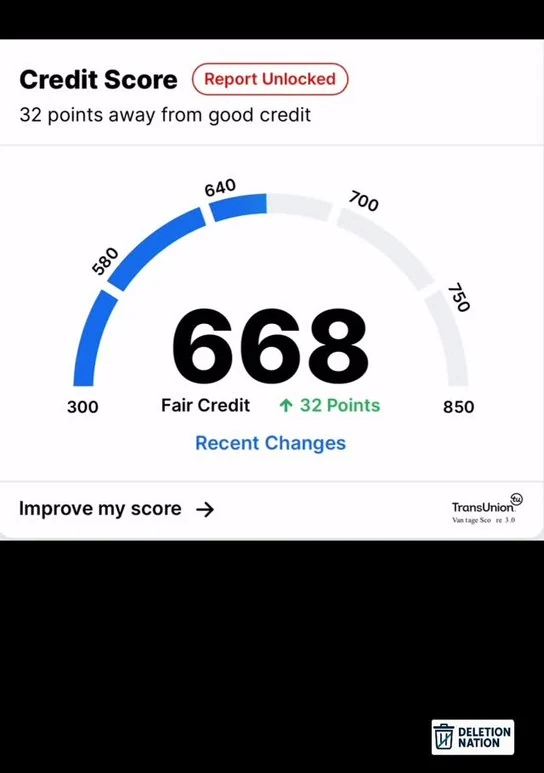
Three TransUnion clients cleared back to back in August 2025. One client had 8 inquiries deleted in a single sweep; another had Apple Card, Comenity, CareCredit, and USAA accounts removed; a third had a Synchrony account deleted. One client rose 32 points overnight, to 668.
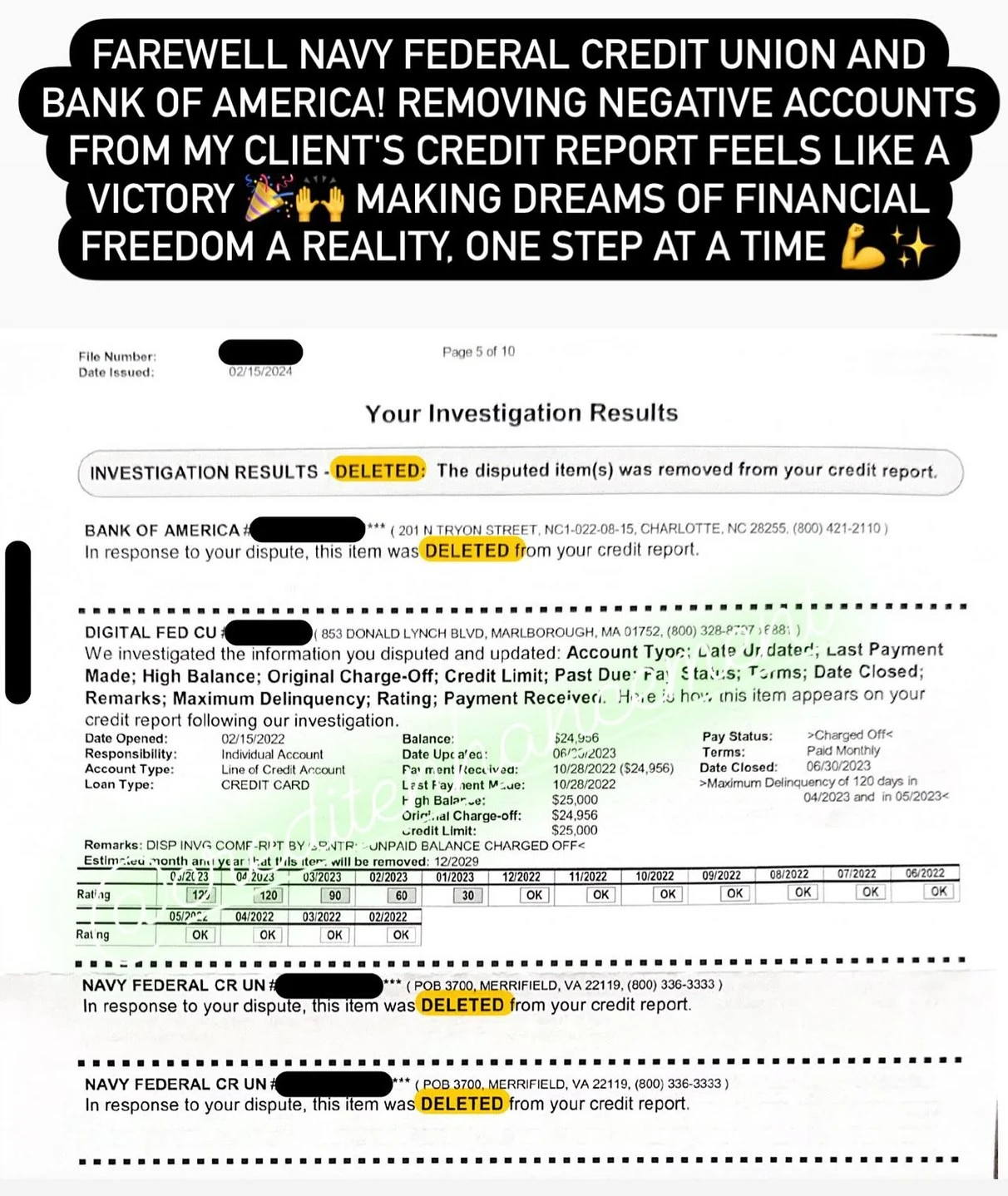
A February 2024 bureau investigation letter showing a Bank of America account and two Navy Federal accounts deleted from a client's credit report after dispute.
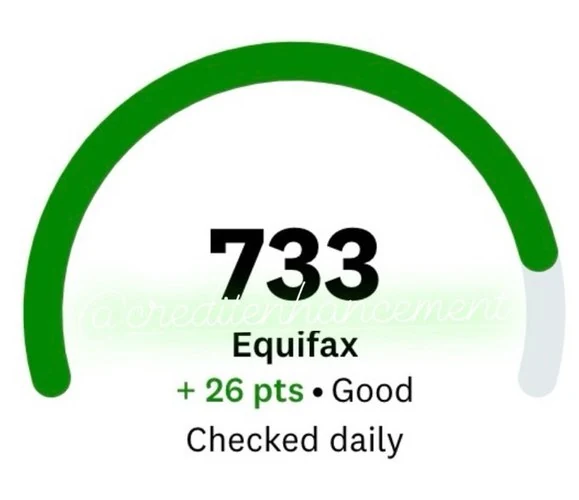
A client reached 733 on Equifax after a 26-point increase, March 2024.
Results vary from person to person and depend on what is in each credit file. Nothing here promises a particular score increase or deletion.
You can't plan a timeline around a guess. Read your scores and entries from all three bureaus first — that's the starting point every timeline is measured from.
For a dollar, you can read your scores and entries from Equifax, Experian, and TransUnion before you decide what to do about them.
A dollar with MyScoreIQ opens 7 days of access to your scores, then $34.99 a month if you keep it. Cancel anytime.
Credit Repair Timelines can look different from one report to the next. We help you understand the details and spot accuracy problems.
We review your reports and sort the errors from the accurate negatives, because they have very different timelines.
We explain the 30-day investigation cycle and why a file usually needs more than one round.
We talk through paying down balances — the fastest legitimate lever — and correcting genuine errors.
We explain what the months after the disputes look like, and what builds a score over time.
We talk honestly about files with a bankruptcy or foreclosure, and what improvement looks like there.
A Credit Repair Timelines entry feels personal, but on a report it is just data — dates, amounts, and a status. We help you read it as data first.
The same account can look different on each bureau. We help you check all three before you act on any one of them.
We explain dispute options, what records to keep, and practical habits that help you stay current going forward.
We talk through your reports and flag what can actually be fixed.
We help you understand how long your file is likely to take, based on what is in it.
We talk through what to send, where to send it, and how to track the results.
We explain the habits and accounts that build a score over the months that follow.
It depends on the file. A file with clear errors can improve in one dispute round — about 30 days per round. A file with accurate negatives improves over months as new on-time history builds and old items age.
Bureaus generally have 30 days to investigate a dispute once they receive it, and they send the results in writing.
Paying down credit card balances is usually the fastest legitimate lever, because utilization updates monthly. Correcting a genuine error is the second-fastest.
Not honestly, for most files. A single dispute round takes about 30 days, and most files need more than one round plus months of rebuilding. Anyone who promises a fixed result in days is not describing how the system works.
Most negative items stay for about seven years — Chapter 7 bankruptcy up to 10 years, hard inquiries about two years. Accurate items generally stay for the full window.
Paying a collection changes its status to paid, but it does not automatically remove it. Some newer scoring models treat paid collections more kindly, but the improvement is gradual, not instant.
No promises, no fixed dates — just a clear look at what's in your file and what it will take. Let's read your reports together. Call (346) 301-6424.