Repossessions on Your Report
A Repo Is a Heavy Mark — Here's How to Work Through One
In a city where a truck is often how you get to work — from the Ship Channel to the Energy Corridor, from Katy to Baytown — losing a vehicle to repossession hurts twice: once when the truck is gone, and again every time the repo shows up on your credit report. Here's what a repossession entry means and what can be done about it.
A repossession usually shows up in two places on a credit report: the original auto loan, marked as repossessed or charged off, and possibly a separate collection account if a deficiency balance was sent to a collector. The deficiency is the difference between what you owed and what the lender got when it sold the vehicle — and in Texas, that balance can be substantial, because a repossessed truck sold at auction rarely brings what it was worth on the lot.
A repossession generally stays on a credit report for about seven years from the date of the first missed payment that led to it. Like other serious negative items, it weighs heavily in scoring at first and less as it ages, especially if the rest of the file shows on-time payments afterward. Paying the deficiency balance changes the account's status, but it does not erase the repossession history — and it does not restart the seven-year window.
Texas has specific rules about repossession. A lender generally cannot breach the peace to take a vehicle — no breaking into a locked garage, no confrontation — and after the sale it must account for the sale price and give you notice of any deficiency it claims. Those rules matter because a repossession that did not follow the required process can create an accuracy problem on the report, and accuracy problems can be disputed.
Step 1 — Read every entry tied to the repo. Pull your reports from all three bureaus at annualcreditreport.com, the official site. Note the lender, the original loan balance, the repo date, the deficiency balance, and whether a collection account for the same debt also appears. Duplication and mismatched balances between bureaus are common and worth flagging.
Step 2 — Check the facts against your records. Payment history before the repo, the date of the first missed payment, the sale price of the vehicle, and any deficiency notice the lender sent you. If the lender's numbers do not match your records — a payment made before the repo date, a sale price that looks wrong, a deficiency that does not add up — document it.
Step 3 — Dispute what is inaccurate. Dispute with the bureau that shows the error and with the lender. Be specific: name the field, state the correct value, attach copies of your proof. Bureaus generally have 30 days to investigate, and they must correct or remove information they cannot verify.
Step 4 — Deal with the deficiency balance deliberately. If a deficiency balance is real and accurate, you have choices: negotiate a settlement, set up a payment arrangement, or, if the balance is old and the reporting window is nearly over, wait it out. Before you pay anything, get the agreement in writing — the amount, the payment schedule, and exactly how the account will be reported afterward. A removal agreement is never guaranteed and should never be assumed from a phone call.
Step 5 — Rebuild the transportation piece. If you need another vehicle, a smaller, affordable payment reported on time does more for a credit file than any dispute letter. Some Houston-area credit unions and community lenders work with borrowers rebuilding after a repo, and a modest loan paid on time for a year or two is one of the strongest rebuilding signals there is.
Do not ignore a deficiency balance and assume it goes away — it can be sold to a collector, and a collector can sue within the statute of limitations. Do not agree to a payment plan on the phone without seeing the terms in writing. And do not fall for a company that promises to remove a repossession from your report for a fee: an accurate repo generally stays for about seven years, and no one can promise otherwise.
Also, do not let the repo stop you from checking the rest of your file. A repossession often arrives alongside other damage — late payments on the same loan in the months before the repo, a collection for the deficiency, a new hard inquiry from a replacement vehicle loan. Each entry deserves its own look, because each one has its own accuracy questions and its own timeline.
When you dispute by mail, send it to the bureau that shows the item. The mailing addresses are: Experian, P.O. Box 4500, Allen, TX 75013; Equifax, P.O. Box 740256, Atlanta, GA 30374; and TransUnion, P.O. Box 2000, Chester, PA 19016. Bureaus generally have 30 days to investigate a dispute once they receive it. Send disputes by certified mail and keep a copy of everything you send, along with the delivery confirmation.
If this guide helped, these pages go deeper on the topics that usually come up next.
These are actual results from past clients, previously shared on Instagram. Every credit file is different, so treat these as examples of what the process can look like, not as a promise of what yours will do.
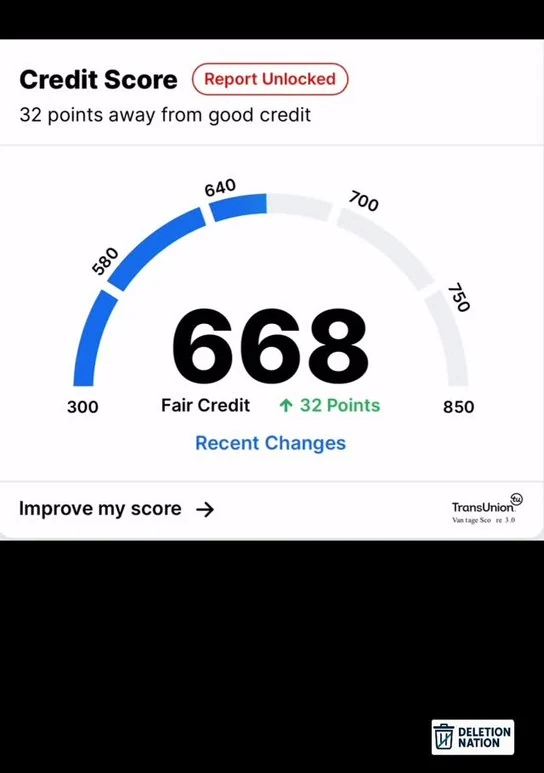
Three TransUnion clients cleared back to back in August 2025. One client had 8 inquiries deleted in a single sweep; another had Apple Card, Comenity, CareCredit, and USAA accounts removed; a third had a Synchrony account deleted. One client rose 32 points overnight, to 668.
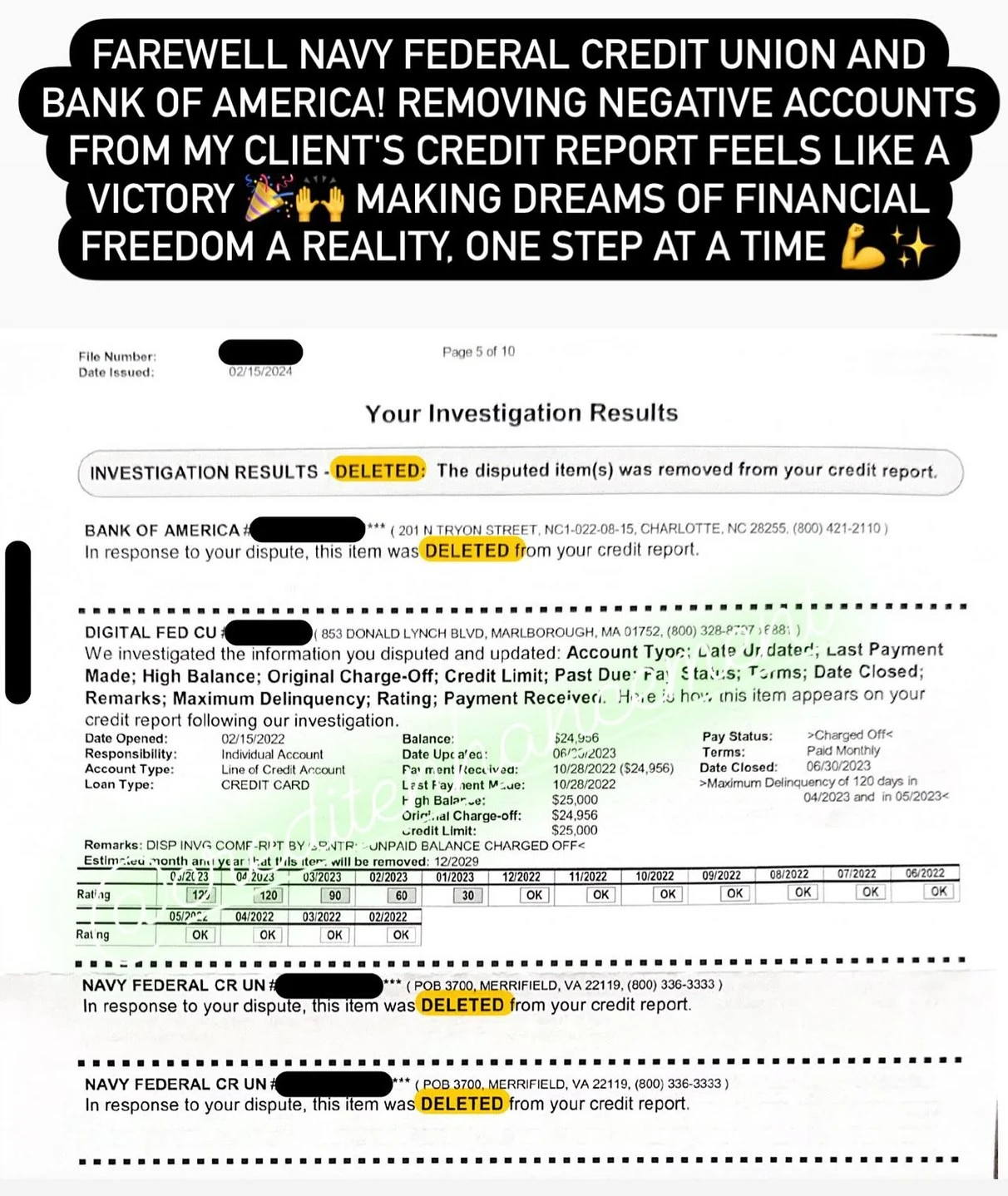
A February 2024 bureau investigation letter showing a Bank of America account and two Navy Federal accounts deleted from a client's credit report after dispute.
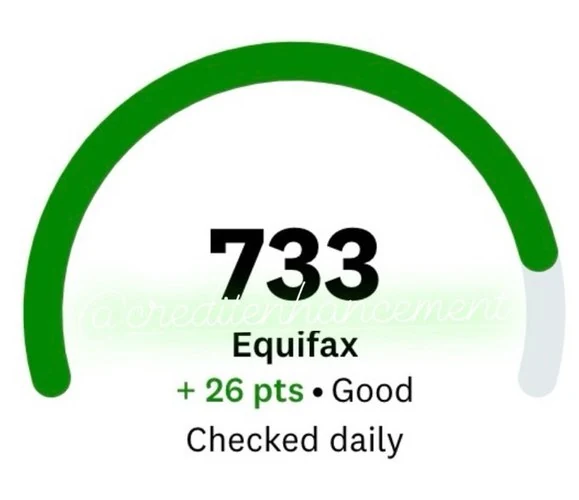
A client reached 733 on Equifax after a 26-point increase, March 2024.
Results vary from person to person and depend on what is in each credit file. Nothing here promises a particular score increase or deletion.
You can't challenge what you can't see. Read the repossession entry — the lender, the balance, the dates — across all three bureaus before you contact anyone.
For a dollar, you can read your scores and entries from Equifax, Experian, and TransUnion before you decide what to do about them.
A dollar with MyScoreIQ opens 7 days of access to your scores, then $34.99 a month if you keep it. Cancel anytime.
Repossessions can look different from one report to the next. We help you understand the details and spot accuracy problems.
We review how the auto loan is reported — the balance, the repo date, and the account status on each bureau.
We help you check the remaining balance against the sale price and the notices the lender sent.
We look for the same debt reported twice — as the loan and as a collection — and for balances that don't match.
We help you spot dates, balances, or statuses that do not match your records.
We explain what a written agreement should say before you send a payment.
A Repossessions entry feels personal, but on a report it is just data — dates, amounts, and a status. We help you read it as data first.
The same account can look different on each bureau. We help you check all three before you act on any one of them.
We explain dispute options, what records to keep, and practical habits that help you stay current going forward.
We talk through the repo-related entries showing on your credit reports.
We help you review the reported dates, the deficiency balance, and the account status.
We help you identify information that appears inaccurate, incomplete, or inconsistent with your records.
We explain dispute, settlement, and rebuilding options in plain language.
A repossession generally stays for about seven years from the date of the first missed payment that led to it.
Paying the deficiency changes the account's status, but it does not automatically remove the repossession entry. A removal only happens if the lender or collector agreed to it in writing beforehand, and that is never guaranteed.
Yes, when the information in it is wrong — a wrong balance, a wrong date, a payment made before the repo, or a deficiency that does not add up. Accurate repossessions generally stay.
It can appear as the original auto loan and as a separate collection account for the deficiency balance. If two collectors report the same deficiency, that duplication is worth disputing.
Often yes. The deficiency balance — what you owed minus what the lender got at sale — can still be collected, and in Texas it can be pursued within the statute of limitations.
Not always, but it will usually raise the rate and may require a larger down payment. A smaller loan paid on time afterward is one of the strongest ways to rebuild.
A repo entry deserves a close look before you pay a dollar toward the balance. Let's go through what the bureaus are showing and talk about your options. Call (346) 301-6424.