Checking Your Report
Reading Your Own Report Is the First Skill of Credit Repair
Most credit problems start with a report nobody has read. An error sits there for years, a collection nobody recognizes, an address that isn't yours — all of it visible to anyone who pulls the file, and invisible to the person it belongs to. Checking your report is a skill, and this guide teaches it.
Your credit reports come from three bureaus — Equifax, Experian, and TransUnion — and the official site to get all three is annualcreditreport.com. That site is run under federal law, and it is the only place the bureaus are required to provide your reports. Other sites offer reports too, but many of them are selling a subscription alongside the report, and the report they show may not be the full file a lender sees.
Check all three reports, not just one. The bureaus do not share information with each other, and an error often appears on only one or two of them. A collection that shows on TransUnion but not on Equifax is still a problem — a lender that pulls TransUnion will see it. Checking all three, at least once a year and more often if you are working on your credit, is the habit that catches problems early.
Your credit score is not on the report itself — the report is the data, and the score is a number calculated from that data. Many banks, card issuers, and the $1 trial on this page show scores alongside the reports, and those are useful for tracking. But the report is the source of truth: if the data is wrong, the score is wrong, and fixing the data is what fixes the score.
Start with the personal information section: your name, addresses, employers, and date of birth. Errors here — a misspelled name, an address you never lived at, an employer you never worked for — can signal a mixed file, where another person's information has landed on your report. If you see an address in a part of Houston you have never lived in, flag it.
Next, read every account. For each one, check the creditor name, the account number, the date opened, the balance, the credit limit, the payment history, and the status. Look for accounts you do not recognize, balances that do not match your records, accounts shown as open that you closed, and accounts shown as past due that you paid on time. Pay special attention to the payment history grid — a single month marked late in a sea of on-time months is easy to miss and easy to dispute if it is wrong.
Then read the negative items: collections, charge-offs, bankruptcies, foreclosures, and judgments. For each, check the creditor, the balance, the date of first delinquency, and the status. A collection for a debt you already paid, a charge-off with the wrong balance, or a negative item past its reporting window are all worth disputing.
Finally, read the inquiries. Hard inquiries show who pulled your credit and when. Match each one against applications you submitted. An inquiry from a company you never dealt with is worth disputing — and can be an early sign of identity theft. Soft inquiries do not affect your score and are listed separately.
Write down every error you find, with the bureau, the account name, the account number, and exactly what is wrong. Gather the documents that prove the correction — bank statements, payment confirmations, payoff letters, account closure letters — and dispute each error with the bureau that shows it and with the creditor. Bureaus generally have 30 days to investigate, and they send the results in writing.
If you find an account you do not recognize at all, treat it as a possible identity theft issue: place a credit freeze, file an identity theft report at identitytheft.gov, and read our identity theft guide before you dispute. If you find a small error — a wrong address, a misspelled name — dispute it too, because personal information errors can be the first sign of a mixed file.
Keep a folder — paper or digital — with a copy of every report you pull, every dispute you send, and every result you receive. Credit repair is a process that runs over months, and the folder is what keeps you from re-disputing the same error twice or losing track of which bureau corrected what. Check your reports again 30 to 60 days after a dispute to confirm the correction stuck on all three bureaus.
When you dispute by mail, send it to the bureau that shows the item. The mailing addresses are: Experian, P.O. Box 4500, Allen, TX 75013; Equifax, P.O. Box 740256, Atlanta, GA 30374; and TransUnion, P.O. Box 2000, Chester, PA 19016. Bureaus generally have 30 days to investigate a dispute once they receive it. Send disputes by certified mail and keep a copy of everything you send, along with the delivery confirmation.
If this guide helped, these pages go deeper on the topics that usually come up next.
These are actual results from past clients, previously shared on Instagram. Every credit file is different, so treat these as examples of what the process can look like, not as a promise of what yours will do.
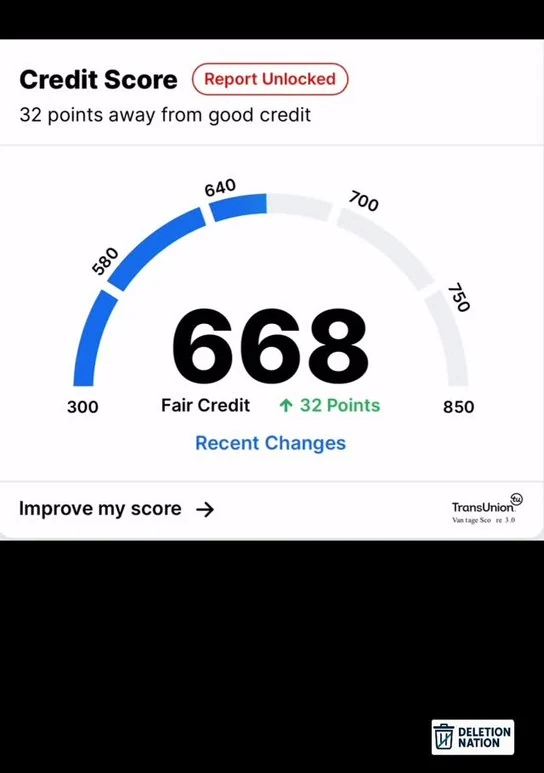
Three TransUnion clients cleared back to back in August 2025. One client had 8 inquiries deleted in a single sweep; another had Apple Card, Comenity, CareCredit, and USAA accounts removed; a third had a Synchrony account deleted. One client rose 32 points overnight, to 668.
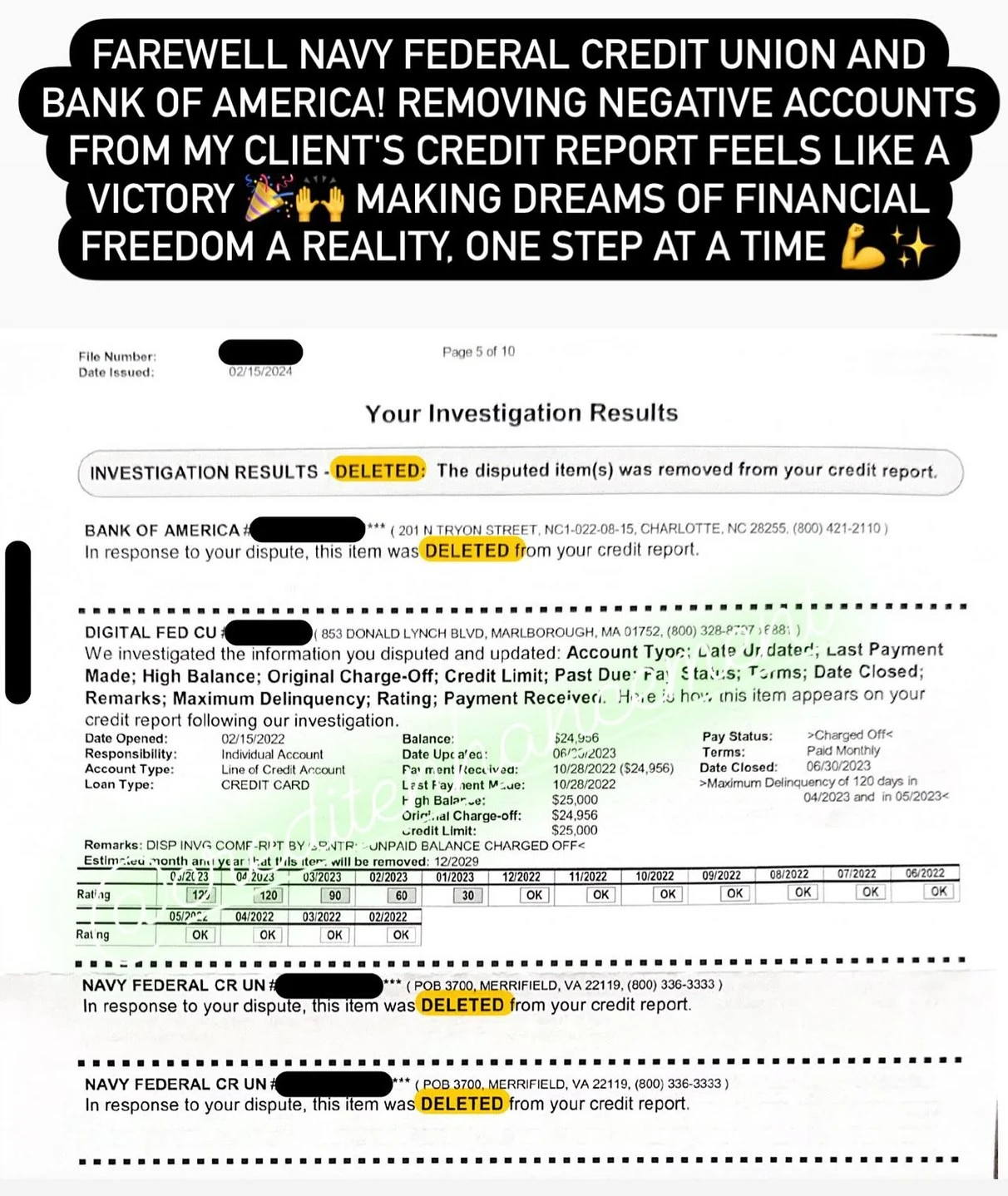
A February 2024 bureau investigation letter showing a Bank of America account and two Navy Federal accounts deleted from a client's credit report after dispute.
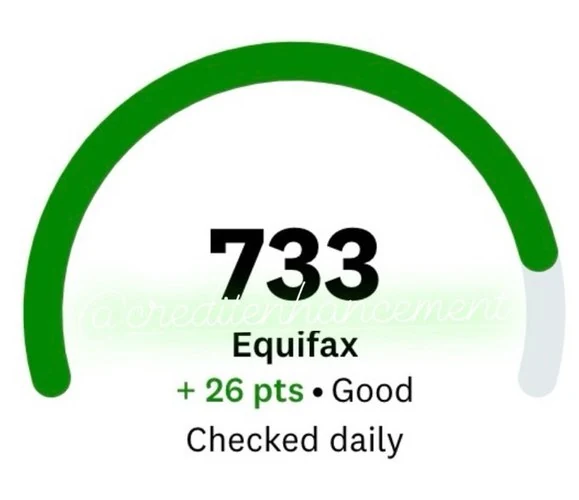
A client reached 733 on Equifax after a 26-point increase, March 2024.
Results vary from person to person and depend on what is in each credit file. Nothing here promises a particular score increase or deletion.
You can't challenge what you can't see. Read your scores and entries from all three bureaus side by side — that's where errors show up.
For a dollar, you can read your scores and entries from Equifax, Experian, and TransUnion before you decide what to do about them.
A dollar with MyScoreIQ opens 7 days of access to your scores, then $34.99 a month if you keep it. Cancel anytime.
Checking Your Report can look different from one report to the next. We help you understand the details and spot accuracy problems.
We review the names, addresses, and employers on your file for signs of a mixed file.
We go through each account line by line — balances, limits, payment history, and status.
We review collections, charge-offs, and other negative entries for accuracy and dates.
We help you match each hard inquiry against applications you actually submitted.
We help you build the list of errors worth disputing, with the proof for each one.
A Checking Your Report entry feels personal, but on a report it is just data — dates, amounts, and a status. We help you read it as data first.
The same account can look different on each bureau. We help you check all three before you act on any one of them.
We explain dispute options, what records to keep, and practical habits that help you stay current going forward.
We talk through where to get your reports and how often to check them.
We go through your reports with you and flag what does not match your records.
We help you identify errors, mixed-file signs, and identity theft signals.
We explain what to send, where to send it, and how to track the results.
At annualcreditreport.com, the official site, where you can get your reports from Equifax, Experian, and TransUnion.
Yes. The bureaus do not share information, and an error often appears on only one or two of them. A lender that pulls the bureau with the error will see it.
At least once a year, and more often if you are working on your credit, applying for a loan, or have found an error before.
No. The report is the data, and the score is calculated from that data. Scores are shown separately by banks, card issuers, and monitoring services.
Wrong balances, accounts shown as past due that were paid on time, accounts that are not yours, and personal information errors that signal a mixed file.
Treat it as a possible identity theft issue: place a credit freeze, file an identity theft report at identitytheft.gov, and dispute the account with the bureau and the creditor.
If the answer is never — or not in years — it's time. Let's pull your three reports and read them together, line by line. Call (346) 301-6424.